
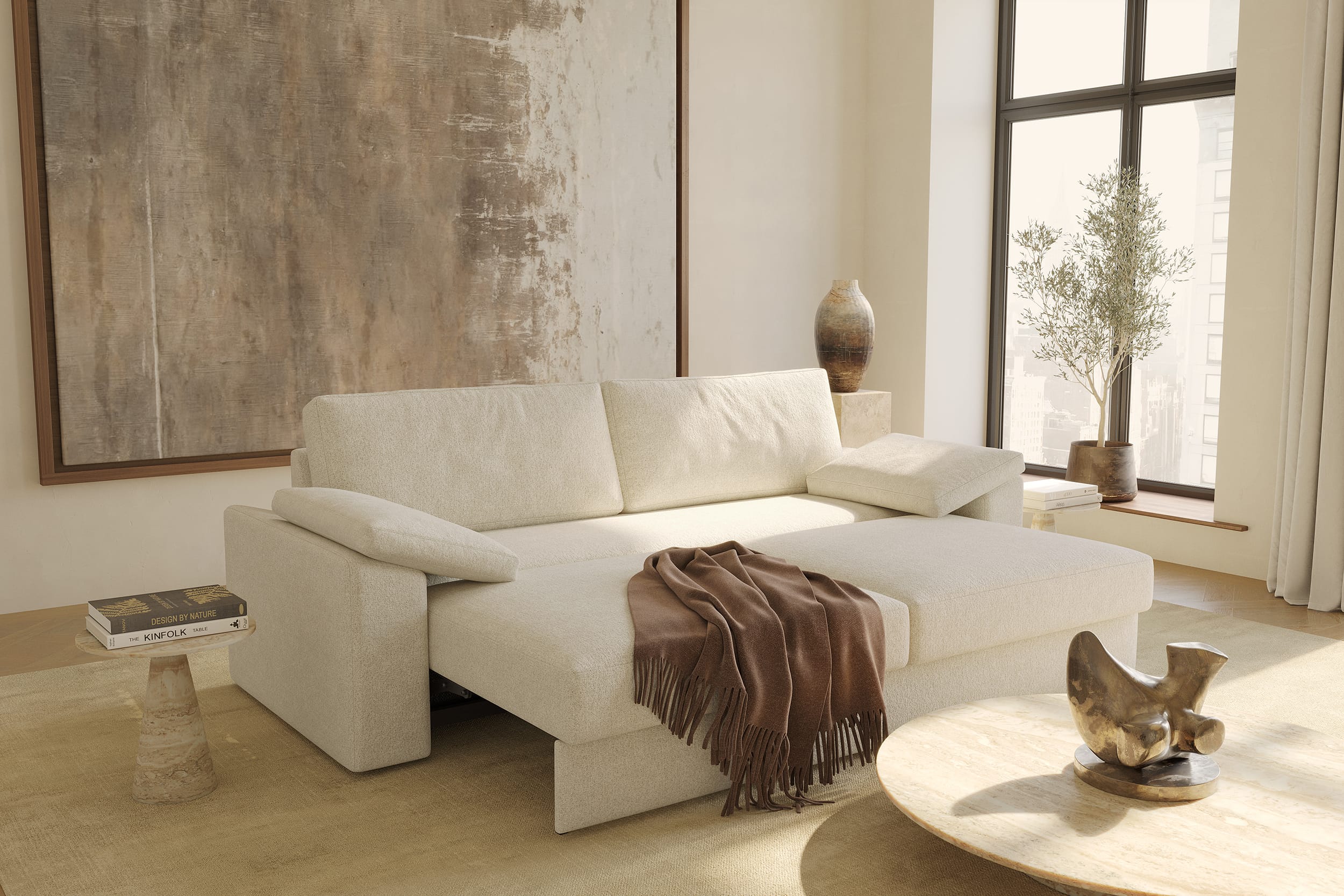
A studio apartment has one set of walls doing the job three or four rooms usually do. Zoning is how you make that work — not by adding walls, but by using furniture, scale, and sightlines to signal where one function ends and another begins. This is a longer-term furniture strategy for daily living, not a one-off setup for when guests arrive.
Start with function, not furniture
Before arranging anything, list the functions your one room actually needs to support — sleeping, working, eating, relaxing, storage — and be honest about which ones happen daily versus occasionally. A desk you use eight hours a day deserves a defined zone with real thought behind it. A dining setup you use twice a month can be more flexible, even foldable, rather than claiming permanent square footage.
This ordering matters because it’s tempting to zone a studio the way you’d furnish separate rooms — one zone per function, evenly weighted. In a genuinely small space, the functions you use daily should get disproportionately more consideration than the ones you use rarely.
Furniture scale is doing more work than you think
Oversized furniture is the single most common studio mistake, and it undermines zoning specifically — a piece too large for its intended zone visually spills into the next one, blurring the boundary you’re trying to create.
Choose furniture sized for the zone, not the room. A sofa bed sized correctly for a “living zone” that’s actually two-thirds of your studio will look right; the same piece crammed into a third of the room designated as “living” will look oversized regardless of how nice it is. Compact models like Cubed exist partly to solve this — sized to hold its zone without dominating the whole room.
Lower-profile furniture reads as less visually heavy. A piece that sits lower to the ground, or has visible legs rather than a solid base, takes up the same floor footprint but reads as smaller because more of the floor and wall behind it stays visible. This is part of why the design language across this range — visible legs, restrained silhouettes — works particularly well in studio zoning specifically, beyond just being a style preference.
Sightlines define zones more than furniture does
Where your eye travels when you enter the room does more to establish zones than the furniture placement itself.
Anchor each zone with a clear focal point. A sofa bed facing a specific wall or window reads as an intentional living zone; the same piece placed with no clear orientation reads as furniture parked in available space. A desk facing a wall or window, rather than facing into the room, similarly signals “this is a distinct activity” rather than an extension of the living area.
Use the tallest furniture as a soft boundary. A bookshelf, a tall plant, or an armless sofa bed floated away from a wall — its back becomes the visual edge of one zone and the start of another, without eating floor space the way a real partition would.
Keep sightline “gaps” intentional, not accidental. If your eye can travel unobstructed from the front door straight to the far wall, the room reads as one big undifferentiated space no matter how you’ve grouped the furniture. A single well-placed tall piece — even just a floor lamp — breaking that direct sightline does a surprising amount to create the feeling of separate areas.
Furniture that does more than one job
In a studio, furniture that serves only one function is a luxury most layouts can’t afford. A few principles:
The sofa bed is already doing double duty — living-room seating and a bed — which is the core reason it belongs in a studio in the first place. Beyond that single piece, look for opportunities elsewhere: a storage ottoman that’s simultaneously a coffee table, extra seating, and storage; a wood tray accessory that turns a sofa arm into a side table without adding a separate piece of furniture.
Avoid pieces that only work in one configuration. A large, fixed dining table works against a studio’s flexibility; a smaller table that can be pushed against a wall when not in active use, or that doubles as a desk, earns its square footage on more days of the week.
Where to actually place the sleeping zone
The sleeping zone — wherever your sofa bed opens — benefits from being the zone furthest from the entry and from high-traffic paths, since it’s the area most disrupted by foot traffic and the one that benefits most from feeling separate. If your studio’s layout allows it, positioning the sofa bed at the far end from the door, even if that means the “living” function nominally sits closer to the entry, tends to work better for daily use than the reverse.
This is worth deciding before you commit to a specific arm style or configuration — see our arm styles guide for how a slim or armless option can help the piece work in whichever spot the room actually calls for.
What this looks like day to day
The test of good zoning isn’t how the room photographs — it’s whether you can walk into it after a long day and immediately understand which part is for working, which is for relaxing, and which is for sleeping, without having to think about it. A studio that requires active thought each time to remember “which mode” the room is in hasn’t been zoned effectively yet, regardless of how much furniture is in it.
If you find yourself constantly using the whole room for whatever activity you’re doing at the moment — working from the sofa, eating at the desk — that’s usually a sign the zones aren’t distinct enough, either in scale, sightline, or furniture choice, to actually pull you into the right one.
Frequently asked questions
What’s the biggest mistake people make zoning a studio apartment? Sizing furniture for the room instead of for its specific zone. Oversized pieces visually spill into neighboring zones and erase the boundary zoning is meant to create.
Do I need a room divider to create zones in a studio? Not necessarily. Furniture scale, sightlines, and a tall anchor piece — a shelf, a plant, a floated sofa bed — can create effective visual boundaries without a physical partition.
Where should the sleeping zone go in a studio? Generally as far from the entry and high-traffic paths as the layout allows, since it benefits most from feeling separate from daily foot traffic.
How do I know if my zoning is actually working? You should be able to enter the room and immediately sense which area is for what, without conscious effort. If you find yourself using the whole room interchangeably for every activity, the zones likely aren’t distinct enough yet.
Zoning is a long-term furniture strategy, not a one-time layout decision — it’s worth revisiting as your daily use of the space evolves. See our guide to choosing a sofa bed for a studio apartment for the furniture side of the equation, or get in touch with your room’s dimensions for specific guidance.