
A functional home office in a small apartment isn’t about finding room for a desk — almost any apartment has room for a desk. It’s about making that desk feel like a genuine workspace rather than a table shoved into whatever corner was left over, while the rest of the room keeps doing its other jobs. Here’s how to actually set that up.
Start with placement, not the desk itself
Face the desk toward a wall or a window, not into the center of the room. A desk oriented into open floor space reads as an extension of the living area rather than a distinct workspace, which undermines the mental separation between “work mode” and everything else — genuinely useful for focus, and for signaling to anyone else in the space that you’re working.
Natural light matters more for a desk than for almost any other furniture placement. If you have a choice of walls, prioritize one near a window. Working in dim light for hours daily has a real effect on both focus and eye strain that a desk lamp only partially compensates for.
Corners are underused for desks specifically. A corner desk, or a straight desk angled into a corner, claims a section of the room that’s otherwise often dead space, without interrupting the room’s main walking path the way a centrally placed desk would.
The desk itself: sizing for a small room
A narrow desk against a wall beats a large desk in the middle of the room, even if the large desk technically offers more surface area. In a small apartment, the desk’s footprint competes directly with everything else the room needs to do, so a slim profile that still fits your monitor and keyboard comfortably is usually the better trade.
A desk with some built-in storage — a drawer, a shelf — reduces the need for a separate filing cabinet or storage unit elsewhere in the room. This follows the same multi-function logic that matters throughout small-space furnishing generally.
If floor space is genuinely tight, a wall-mounted fold-down desk claims zero permanent floor space when not in use, at the cost of needing to set up and pack away more actively than a fixed desk.
Lighting, sound, and the things that make it feel like an office
Task lighting, separate from the room’s general lighting, does more for focus than most people expect. A desk lamp specifically for work hours helps mentally separate “office time” from the rest of the day, even in a room that serves multiple purposes.
A small rug under the desk area can help define the zone acoustically and visually, particularly useful in an open-plan space where the office doesn’t have its own walls.
Cable management is a small detail with an outsized effect on how “finished” a workspace feels. A tangle of visible cords reads as improvised; the same setup with cables run along a wall or bundled out of sight reads as a genuine office.
Storage for actual work, not just decoration
Vertical shelving above the desk uses space that would otherwise sit empty, and keeps reference materials, books, or supplies within reach without eating into desk or floor space.
A closed storage option — a cabinet, a lidded bin — for anything you don’t want visible during non-work hours. If the desk area shares a room with living or sleeping space, being able to visually “close” the office at the end of the day matters more than it would in a dedicated room.
The real challenge: when the office also has to be a guest room
This is where a small-apartment home office setup diverges from a generic one. If the room serving as your office also needs to occasionally sleep an overnight guest — common in a one-bedroom used as an office, or a studio where the desk shares space with everything else — the furniture decision gets more complicated than desk placement alone.
An air mattress or folding cot is the lowest-commitment option, storing away completely when not in use, but it does nothing for the room the rest of the time and requires setup for every guest stay.
A daybed functions as genuine seating during work hours and a real bed at night, in a smaller footprint than a full sofa, though sized for one person rather than a couple. See our comparison of daybeds vs sofa beds for a home office if this fits your situation.
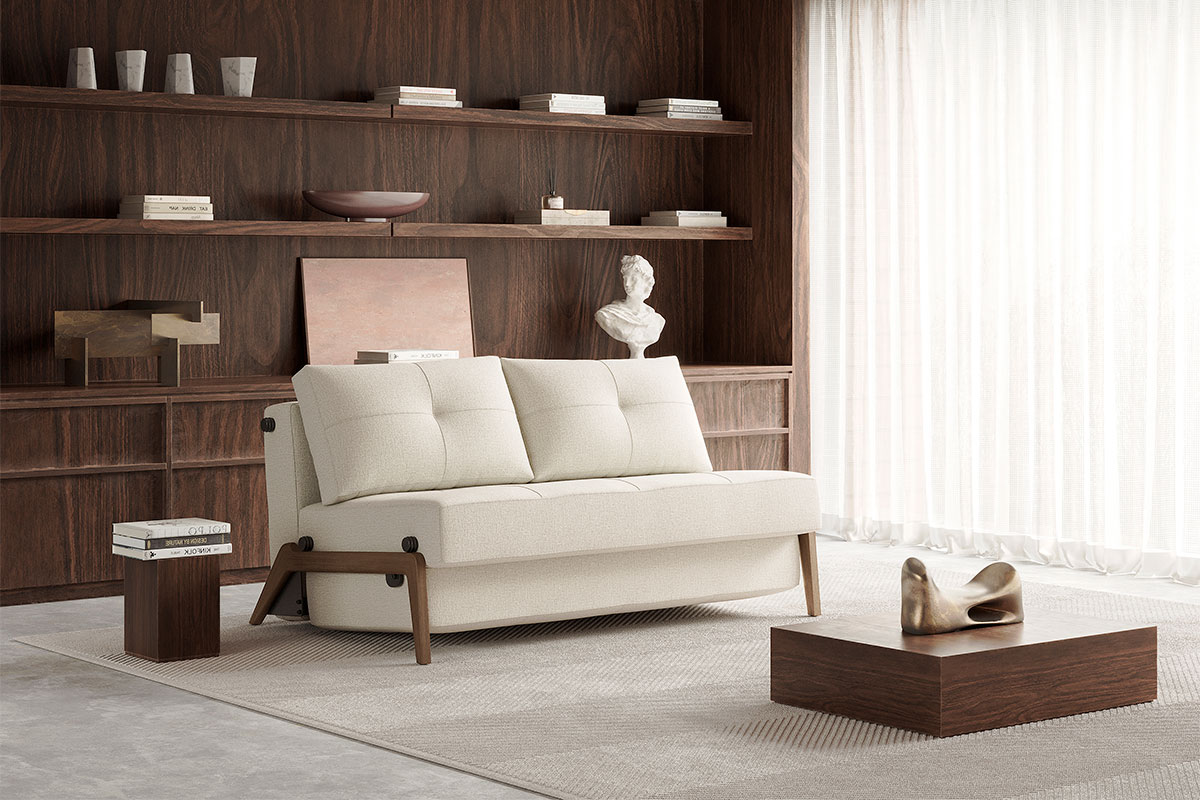
A compact sofa bed does more work in the room day to day — genuine seating for reading or calls, a place for a second person to sit during work hours — while still converting for overnight guests when needed. This is usually the strongest option if the room needs to feel like a real office most of the time and only occasionally shifts into guest-room mode.
If you’re at this stage of the decision, a few things matter more in an office specifically than they would in a pure living room. A mechanism that doesn’t require pulling the piece away from the wall — since a desk is likely already claiming wall space — makes a real difference; several compact sofa bed designs are built specifically to fold forward into the room rather than needing rear clearance. Storage built into the piece itself is also worth prioritizing here, since it gives you somewhere to put guest bedding out of sight on the days the room is functioning purely as an office.
Innovation Living’s range of compact and storage-equipped sofa beds covers exactly this use case — models built for tight footprints, forward-folding mechanisms that don’t need wall clearance, and comfort systems suited to occasional versus regular guest use depending on how often the room actually does double duty. Our guide to daybed vs. sofa bed for a home office compares the two options for a room that works by day and sleeps guests by night.
Frequently asked questions
Where’s the best place to put a desk in a small apartment? Against a wall or facing a window, rather than in the center of the room — this creates a clearer mental and visual separation between work and the rest of the space.
How do I fit an office into a room that’s also my living room? Corner placement, a narrow desk profile, and vertical shelving all help a desk claim minimal footprint. If the same room needs to host guests, a sofa bed or daybed handles double duty better than a fixed desk chair setup alone.
What’s the best guest-sleeping solution for a home office? It depends on how often the room needs to double as a guest space. Occasional single guests are well served by a daybed; more frequent hosting, or needing to sleep a couple, points toward a compact sofa bed instead.
Does a home office need its own dedicated room to feel legitimate? No — a well-placed desk with good lighting and clear visual separation from the rest of the room can feel like a genuine office even in a shared space, without requiring a dedicated fourth wall.
A small-apartment office works best when it’s designed for the room’s other jobs from the start, rather than fighting them. If overnight guests are part of the picture, our guide to daybed vs. sofa bed for a home office covers the furniture side directly, or browse Innovation Living’s collection for compact, storage-equipped options.