
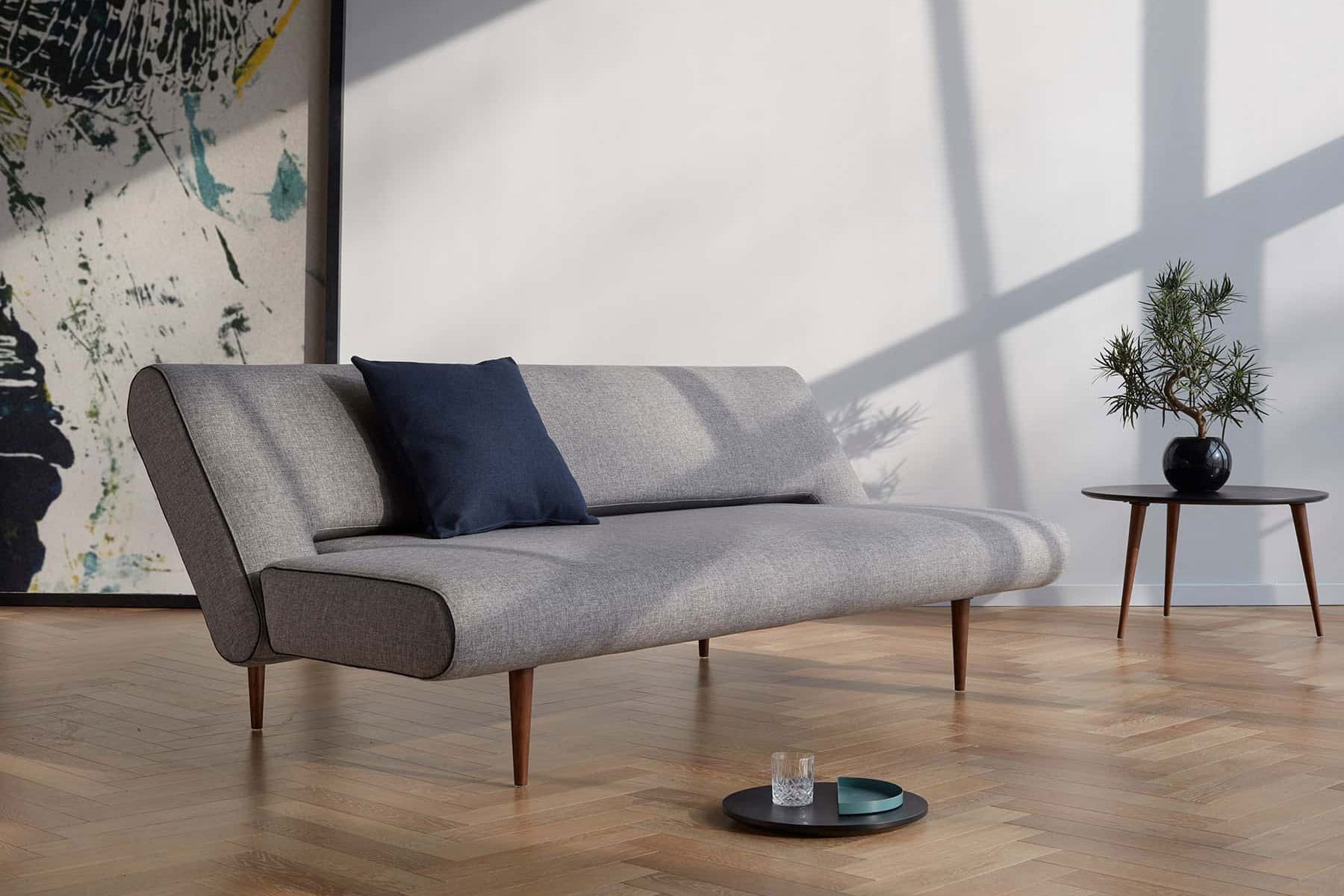
Choosing the right sofa bed solves half the problem. The other half is layout — where it sits, what defines the space around it, and how the room actually functions once the bed is open. A well-chosen piece in the wrong spot still leaves you with a room that doesn’t work.
Start with the traffic path, not the furniture
Before deciding where anything goes, walk the room and note the path you actually use daily — door to kitchen, door to bathroom, the route to a desk if you work from home. That path needs to stay clear whether the sofa bed is open or closed. Everything else gets arranged around it, not the other way around.
This matters more with the bed open than closed, since that’s when the room is at its most constrained. Mark the open bed’s footprint on the floor with tape and walk the space with it “open” before you commit to a layout — it’s the fastest way to catch a conflict before it becomes a nightly annoyance.
Use the sofa bed itself as a room divider
An armless or slim-arm configuration can float in the middle of a studio rather than sitting against a wall, and its back becomes a soft boundary between zones — a living area on one side, a sleeping or work area on the other — without a physical partition eating into the square footage a partition would need.
This works best when the piece isn’t pushed to its absolute limit on width; leave enough clearance on both sides that walking around it doesn’t feel like squeezing past furniture. If your studio is tight enough that floating a full sofa bed isn’t realistic, a compact model like Cubed — which folds forward rather than needing rear clearance — gives you more flexibility for this kind of placement than a model that needs to be pulled off the wall to open.
Layer the zones with rugs and lighting, not walls
Two low-cost tools do most of the zoning work in an open room:
A rug under the seating area defines the “living room” zone visually, even without a physical boundary. If the sofa bed doubles as a guest bed, keep the rug’s edge in mind relative to where the open bed will land — you don’t want a rug edge running directly under where someone will be stepping out of bed.
Distinct lighting for each zone does more to separate functions than most people expect. A floor lamp near the seating area and a different fixture — a wall sconce, a smaller table lamp — near a desk or reading corner signals “this is a different part of the room” even when there’s no wall between them. Overhead lighting alone tends to flatten a studio into one undifferentiated space; layered lighting is one of the more effective low-cost fixes.
Give the guest function its own small footprint
Even in a single room, a guest staying overnight benefits from feeling like they have a defined space rather than being dropped into the middle of your living room. A few ways to create that without adding square footage:
A side table or the wood tray accessory on the sofa bed’s arm gives a guest somewhere to set a phone or a glass of water — a small detail that makes the space feel considered rather than improvised.
Storage that’s actually accessible when needed. If your model has built-in bedding storage, make sure nothing else in the room blocks access to it, since fighting to reach folded sheets under a coffee table defeats the purpose of having storage at all.
A curtain or room divider on a track, if your ceiling and lease allow it, can create a temporary visual separation for a guest’s overnight stay without being a permanent fixture the rest of the time. This is a bigger intervention than rugs and lighting, worth considering only if privacy during a guest’s stay is a real priority rather than a nice-to-have.
What to avoid
Don’t push the sofa bed into a corner if you can help it. A corner placement often looks like it saves space, but it can make the open bed harder to access from more than one side, and it tends to trap the “sleeping zone” against two walls rather than letting it breathe.
Don’t let the coffee table become a nightly obstacle. If a coffee table needs to move every time the bed opens, that’s friction you’ll feel constantly. Either choose a coffee table light enough to move easily, or plan the layout so the bed opens away from it entirely.
Don’t over-furnish the zones. In a studio, every piece of furniture is doing double duty on square footage. Before adding a piece, ask whether it earns its place in a room this size — see our small-space buying guide for the same logic applied to the sofa bed decision itself.
Frequently asked questions
How do I separate a living area from a sleeping area in a studio? Rugs and layered lighting are the two most effective low-cost tools — a rug defines a zone visually, and distinct lighting per area signals a functional boundary without a physical wall. An armless sofa bed floated away from the wall can also serve as a soft divider.
Where should a guest bed go in a one-room apartment? Wherever the open bed’s footprint doesn’t block your daily traffic path — check this by marking the open dimensions on the floor before deciding on a final layout.
Should I put the sofa bed in a corner to save space? Not necessarily. A corner placement can restrict access to the open bed from more than one side. A floated, armless placement often works better if the room allows it.
What makes a guest feel like they have their own space in a studio? Small, specific details — a side table within reach, accessible storage, and if possible a temporary visual divider like a curtain — do more than square footage alone.
Layout and furniture choice work together — the right sofa bed in the wrong spot still leaves friction in daily life. See our guide to choosing a sofa bed for a studio apartment for the furniture side of the decision, or get in touch with your room’s dimensions for layout-specific advice.